About Me

My photo
Las Pinas City, Metro Manila, Philippines

leaf

Wednesday, January 5, 2022

MULBERRY’S HEALTH BENEFITS

MULBERRY IN A POT

MULBERRY is a fruit bearing tree that is easy to care of. The bark, roots, leaves and fruits are all edible and has a potential health benefits, but the leaves specially the dried ones were more used and highly priced from centuries ago. Chinese used the leaves to feed silkworms, but today, many use the leaves as dietary supplements and as a healthy tea.


There are 3 types of mulberry - red, white and black. They are named according to the color of the fruit.

Dried mulberry leaves
Mulberry leaves are used in traditional Asian medicine for its beneficial properties and have since been proven in many clinical trials. The leaves contain minerals and antioxidants, vitamin C, calcium, iron, potassium, phosphorus,
magnesium and zinc. Traditionally, the root bark, leaves and fruits were used as treatment for fever, cough, hyperlipidaemia, hypertension and hyperglycaemia(Chan et al.2016).

Scientific studies suggest that mulberry leaves contain a cluster of bioactive compounds and possess several pharmacological effects - Pharm Biol.2018

HEALTH BENEFITS:

* lowers blood sugar - PLoS One 2027 studies found that leaf extract may reduce blood glucose response after a carbohydrate-heavy meal.

* reduces bad cholesterol- 280grams of leaf powder taken 3times regularly for 3 months helps lower LDL cholesterol and triglycerides: BioMed Research International published 2013

* anti inflammatory effects- mulberry contains flavonoid antioxidants and numerous anti-inflammatory compounds. 

* cold symptoms - the leaf is used to treat liver conditions. It treats headaches, cough, painful eyes, fever and sore throat.

* weight loss- mulberry tea prevents the absorption of carbohydrates due to the presence of miranoline(1-deoxynojirimycine). It helps the body to flush out carbohydrates and starches from the body so that it does not turn into glucose, hunger is reduced by reducing blood sugar levels- Health Benefits Times

* blood vessels health- the tea reduces the chance of artherosclerosis by lessening oxidisation of cholesterol in the blood vessels which is due to the presence of flavonoids and quercetin in the leaves.

* fights diabetes- the tea restricts the high amount of monosaccharide to enter into the circulation. Prevents type 2 diabetes by maintaining the control over blood sugar level.

*  anti cancer
* liver health
* good for skin
* effective against arthritis and fibrosis 

Caution: Pregnant and breastfeeding mothers should stay on the safe side and avoid taking the tea, diabetics should watch signs of low blood sugar and monitor carefully. In some people the tea or eating the leaves may cause bloating, constipation, gas and loose stool. Be cautious in taking tea with your diabetes medications because it might cause your sugar to go too low. The sap from stems and bark may cause irritation to the skin to some. Discontinue taking the tea or eating the leaves if you experience rapid  pulse, breathing difficulties, wheezing and swelling and seek medical advice. 

I love to mix mulberry leaves on sautéed mongo, sardines, or Tinola. I love my Mulberry tea boiled with pandan leaves.  You can also wrap your fish with mulberry leaves when you cook ginataang tilapia.  


Sources:
Healthline
Organifacts net
Pharm Biol 2018
Health Benefit Times 
Livingstrong 

If you need dried or fresh leaves, stem cutting to plant, just send me a message or text 09273870895 or you can order from Facebook market place. Thank you And stay healthy! 

Saturday, March 16, 2013

My ALOE VERA juice
Aloe Vera in My Garden
Surprised to see that the new house I am renting now will give me abundant supply of Aloe Vera gel for my juice and other natural medicinal needs. I got so excited when I saw the small garden beside the house with aloe vera growing just anywhere. Hmmm…I need to replant some of the new ones so they will grow healthier and harvest the big ones. Doing that will also give me a continues supply of aloe gel.

According to natural news .com  “aloe vera is the most impressive herb of them all. (Garlic would be a close second.) There is nothing on this planet that offers the amazing variety of healing benefits granted by aloe vera. In a single plant, aloe vera offers potent, natural medicine that:

• Halts the growth of cancer tumors.
• Lowers high cholesterol.
• Repairs "sludge
blood" and reverses "sticky blood".
• Boosts the oxygenation of your blood.
• Eases inflammation and soothes arthritis pain.
• Protects the body from oxidative stress.
• Prevents kidney stones and protects the body from oxalates in coffee and tea.
• Alkalizes the body, helping to balance overly acidic dietary habits.
• Cures ulcers, IBS, Crohn's disease and other digestive disorders.
• Reduces high blood pressure natural, by treating the cause, not just the symptoms.
• Nourishes the body with minerals, vitamins, enzymes and glyconutrients.
• Accelerates healing from physical burns and radiation burns.
• Replaces dozens of first aid products, makes bandages and antibacterial sprays obsolete.
• Halts colon cancer, heals the intestines and lubricates the digestive tract.
• Ends constipation.
• Stabilizes blood sugar and reduces triglycerides in diabetics.
• Prevents and treats candida infections.
• Protects the kidneys from disease.
• Functions as nature's own "sports drink" for electrolyte balance, making common sports drinks obsolete.
• Boosts cardiovascular performance and physical endurance.
• Speeds recovery from injury or physical exertion.
• Hydrates the skin, accelerates skin repair. “

Most of us only knew of aloe vera’s topical uses. That aloe vera is good for sunburn and promotes hair growth. Few of us knew that aloe vera taken internally is packed with many healing properties.

After taking the gel from the leaf, don’t just throw away the skin. I use the inside part of the skin where the gel was taken out to massage my scalp and hair. We all know that aloe vera promotes hair growth.

Aloe vera also

·  Relieves Scalp Itching
·  Reduces Scalp Redness & Inflammation
·  Adds Strength & Luster To Hair
·  pH Balancing
·  detangles and tames oily hair
·  Heals Scalps Affected By Psoriasis & Seborrhea
·  Easily Penetrates Hair & Scalp
·  Anti- Fungal Properties Alleviates Dandruff
·  Helps Hair Retain Water & Moisture

All these information excites me and I can’t wait for another day to have a glass of aloe vera juice from these harvest and massage my scalp and hair with aloe vera skin.

Aloe Vera juice with Pineapple and Honey
So here is my first glass of Aloe Vera juice from 1-2 big aloe vera leaf, 2-3 slices pineapple and I tbsp. Honey. Put all in the blender and blend until smooth. Hmmmm….yummy!

Aloe Vera juice with Malunggay, Parsley and Pineapple
Here’s another aloe vera juice I made the following from the previous day’s harvest. Blend to liquefy aloe vera gel from 5-6 leaves, a bunch of parsley, a handful of malunggay leaves and 3-4 slices of pineapple. I so love this nutritious and yummy fresh aloe vera juice!

Friday, March 11, 2011

SALUYOT-EDAD50
 SALUYOT

           Saluyot or Jute (Corchorus capsularis L.) is a favorite vegetable of the Ilokanos and thrives almost anywhere in the Philippines. It is also abundant in Asia, Africa and in tropical deserts and wet forest zones. It requires little care in cultivation, and can be grown year-round. I use cuttings to propagate it, some prefer seedlings.

edad50-saluyot
Saluyot(Jute) has been grown for food since 6000 B.C. History has shown that saluyot (Jew mallow or malukhiyah) originated from Egypt and was widely believed to be the source of health and beauty among Egyptian royalties, including the famous Cleopatra.

According to the Department of Science and Technology( DOST), Philippines, 100 grams of saluyot contains an ample amount of Vitamin A, thiamine, niacin, riboflavin, ascorbic acid, phosphorous, iron, potassium, sodium and is also rich in fiber. This green leafy vegetable is rich in beta-carotene for good eyesight, iron for healthy red blood cells, calcium for strong bones and teeth, and vitamin C for smooth, clear skin, strong immune cells, and fast wound-healing. Vitamin C or ascorbic acid improves circulation and helps lower the risk of cataracts and other eye disorders. Eating saluyot regularly helps control blood pressure & cholesterol, and lowers the risk of asthma, cancer, diabetes and heart disease. Dried saluyot leaves can be made into a tea and is believed to cure headaches, dysentery, stomach aches and ulcers. Studies have also shown that saluyot can be used for anti-inflammatory treatment. Saluyot has also been connected with curing the chronic inflammation of the urinary bladder. The Philippine Department of Health advises the public to increase their intake of saluyot or Jute, malunggay and banana in order to build resistance against the threat of swine flu.

EDAD50's SALUYOT
The most important benefit of the leaves is their high antioxidant property, primarily in the form of Vitamin E. Its high antioxidant property reduces the appearance of wrinkles and fine lines in the face and body. Thus, regular consumption of saluyot can make you appear young. These antioxidants combine with free radicals reduces the cause of problems like arthritis, hardening of arteries, heart and kidney ailments

INABRAO of the Ilocanos
The best saluyot dish I’ve ever tasted is the malukhiyah dish in Saudia Arabia. The leaves are pureed and mixed last when the chicken sautéed onion is done. It is best eaten with pita bread. The Ilocanos use saluyot in their preparation of dinengdeng and bulangbulang. Dried or fresh saluyot are also mixed with sautéed bamboo shoots and dried beans. It can be steamed and pureed, mixed with chicken, or prepared into soup like how the Japanese prepare it as molohiya. Some mixes it in sautéed mongo and in soups. It is slimy in character so some people dislike it.

elegant Jute bags
eco-friendly Jute bags
Samples of jute bags from google images made from some varieties of Jute plan. It can also be made into ropes, beautiful rags and decorative items.
 

Tuesday, March 1, 2011

Malabar Night Shade

ALUGBATI
Purple Alugbati

Alugbati ( scientific name: Basella rubra Linn., B.alba Linn) in Tagalog; Malabar Night Shade, Ceylon spinach, or Climbing spinach in English; luo kui shu(Chinese); Pui shak in Bengali; Mong to in Vietnamese; Bertalha in Portuguese is one of the most popular indigenous leafy and stew vegetable in the Philippines.  Alugbati or vine spinach is commonly found in South-East Asia and Africa. It can easily grow in gardens without taking too much care. In some provinces it is propagated as a decorative plant. Alugbati are now being sold in supermarkets, market gardens and home gardens. It is usually planted in home gardens using cuttings. For market gardens, seedlings are transplanted 3 weeks after sowing. It grows well under full sunlight in hot, humid climates and in areas lower than 500 m above sea level. There are three common types of alugbati: Basella alba with green stem and oval to almost round leaves; Basella rubra with red stems and green, oval to round leaves and very common in backyard gardens and the third type is a hybrid of the two. 

Alugbati is a great source of vitamins A, B and C, Iron and calcium and a good source of antioxidant. It is also rich in phosphorous, thiamine, riboflavin,  niacin and ascorbic acid.

Alugbati has a mild spinach flavor and slimy when overcooked. It is an excellent thickening agent in soups and stews. The purplish dye from the ripe fruit is used as a food color and as a rouge for the face. The cooked roots are used to treat diarrhea while the leaves are used as a laxative. The flowers are used as antidote for poison while a paste from the root is used as a rubefacient or is applied to reduce local swellings. A paste from the leaves is used externally to treat boils. Leaf juice mixed with butter is soothing and cooling when applied to burns and scalds.  In  Nigeria, alugbati is used for fertility enhancement in women. In Ayurveda, alugbati is used for hemorrhages, skin diseases, sexual weakness, ulcers and as laxative in children and pregnant women. In some studies, ethanolic and petroleum ether extracts of the leaves of alugbati showed maximum effect against E coli. In some studies, the liquid of the plant is effective for acne eruptions and also eases inflammation. According to studies conducted  by the Research Institute  studies, for Tropical Studies (RITM)  onion, garlic and alugbati proved to be the cheapest and effective in killing mosquito larvae. Extracts of the plants by pounding and squeezing through a blender and then put in the water where the larvae live was proven effective mosquito larvicide.

Wednesday, January 26, 2011

Olasimang Bato

SINAW-SINAW
Granny's sinaw-sinaw
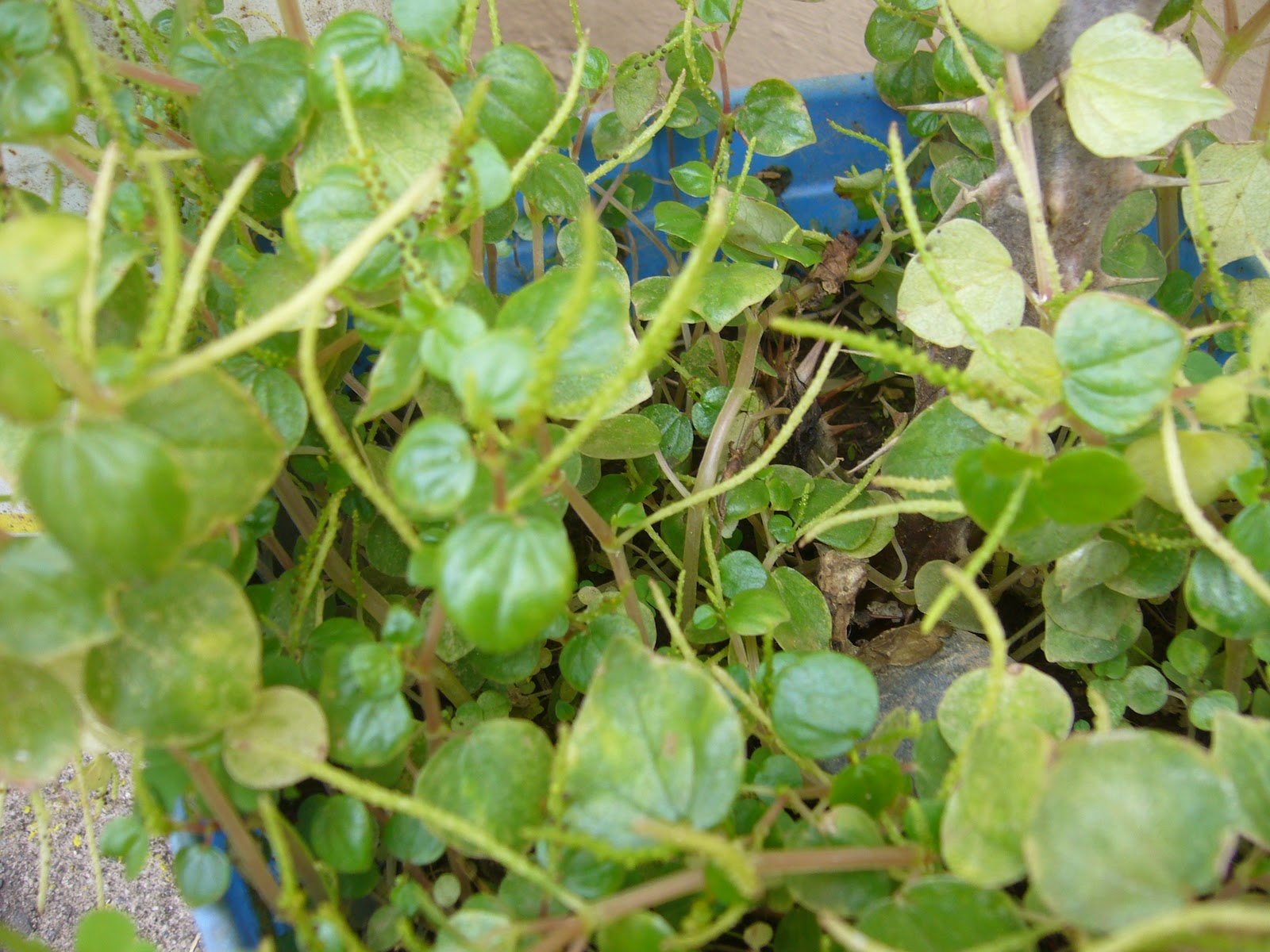
 Sinaw-sinaw (Peperomia pellucida Linn) or tangon-tangon(Bicol) also known  as ‘ulasimang bato’,  ‘pansit-pansitan’(Tagalog), ‘sida-sida’, ‘tangon-tangon’, ‘olasiman ihalas’(Bisaya), or ‘ lin-linnaaw’(Ilocano), is an annual herb, shallow rooted, with succulent stems that often grows in groups in nooks in the gardens,  plant pots, yard or even on top of your uncleaned roof tops. It grows in rocky parts of canals and considered weeds and pulled out by most gardeners. The leaves are heart shaped and turgid, transparent and smooth. It has tiny dotlike flowers scattered along solitary and leaf-opposed stalk. Tiny numerous seeds drop off when mature and grow easily in clumps in any damp area.

Sinaw-sinaw in Granny's backyard
In America, it is known as pepper elder, silver bush, rat ear, man-to-man, clearweed in North America, konsaka wiwiri in Guianas, coraçãozinho or "little heart"  in Brazil, lingua de sapo, herva-de-vidro, herva-de-jaboti or herva-de-jabuti  in South America. The Oceanas called it rtertiil ( Belauan), podpod-lahe or potpopot  (Chamoro).
 
In other parts of Asia, it is known as càng cua (Vietnam); pak krasang (Thailand); suna kosho (Japan); rangu-rangu, ketumpangan or tumpang angin (Bahasa/Malay).

Many Filipinos are still ignorant of this nutritious and medicinal plant so they ignore and pull it away from their backyards. Don’t you know that a 100 gram of Ulisimang Bato could contain 1.1 grams of carbohydrates, 0.5 gram of protein,0.5 gram of fat,94 mg of calcium,13 mg of phosphorus,4.3 mg of iron,1250 ug of beta-carotene and 2 mg of ascorbic acid or vitamin c; which we need in our daily diet, wherein it could be eaten raw as part of a salad meal? The leaves and stems can be eaten as vegetables. I remember my mother mixing it with sautéed mongo bean, or mixed it with other vegetable dish. Sometimes she would make a very yummy salad that has the crispness of a carrot stick and celery.

In terms of medicinal value, Ulasimang bato could help one in their arthritis, headache and convulsion, abdominal pains, kidney problems, skin problems and gout. It could also decrease one’s Uric acid and tophi formation if one has high Uric acid levels. In Bolivia, a decoction of roots is used for fever, and aerial parts for wounds while in Brazil, it is used to lower cholesterol, for treatment of abscesses, furuncles and conjunctivitis.
Ulasimang bato is also antipyretic (that is why it relieves headache), antifungal (which kills particularly the Trichoployton mentagrophytes fungal parasite) and antibacterial (which kills bacterias like Bacillus subtilis, Escherichia coli, Pseudomonas Aeruginosa, and Staphylococcus Aureus bacteria).


Sinaw-sinaw Tea
Sinaw-sinaw or ulasimang bato is popular for the treatment of gout and arthritis. Leaves and stems of the fresh plant maybe eaten as salad or as a medicinal tea. Infuse or put a 20cm. plant in 2 glasses of boiling water. Take ½ cup of this infusion in the morning and 1/2 cup in the evening. Or a decoction of the leaves taken 3 times a day every after meal. Here is how to do it; wash the leaves thoroughly, cut and chop into small pieces. Boil in 2 glasses of chopped leaves with 4 glasses of water, let it boil for 15 minutes under low fire without cover, cool then strain. Drink 1/3 glass of this decoction 3 times a day after each meal.

Sinaw-sinaw  is also good for cleansing the kidney. Put fresh leaves in a pitcher of water and drink it daily.  For kidney stones and those with high uric acid levels, boil 8 inches of plant for every two glasses of water. Drink ten (10) glasses a day for a month. This dissolves kidney stones. Toward the end of the program, you would notice you urinate cloudy, milky stone-filled urine. Continue drinking the brew for a few days more for good measure. This program cleans the kidneys of lithiasis and, thereby, cures Renin-induced secondary hypertension where the underlying cause of renin secretion is kidney lithiasis.

It can be used as facial rinse for complexion problems. Pounded whole plant is used as warm poultice for boils, pustules and pimples.

However, lactating women or a breastfeeding mother and pregnant women should not take or use sinaw-sinaw. Even those who have asthma –like symptoms should not take sinaw-sinaw as it might be triggered by hypersensitivity reactions to certain plant species.


Sign up for PayPal and start accepting credit card payments instantly.